Games I Played In 2025 - Spirit Hunter: Death Mark II
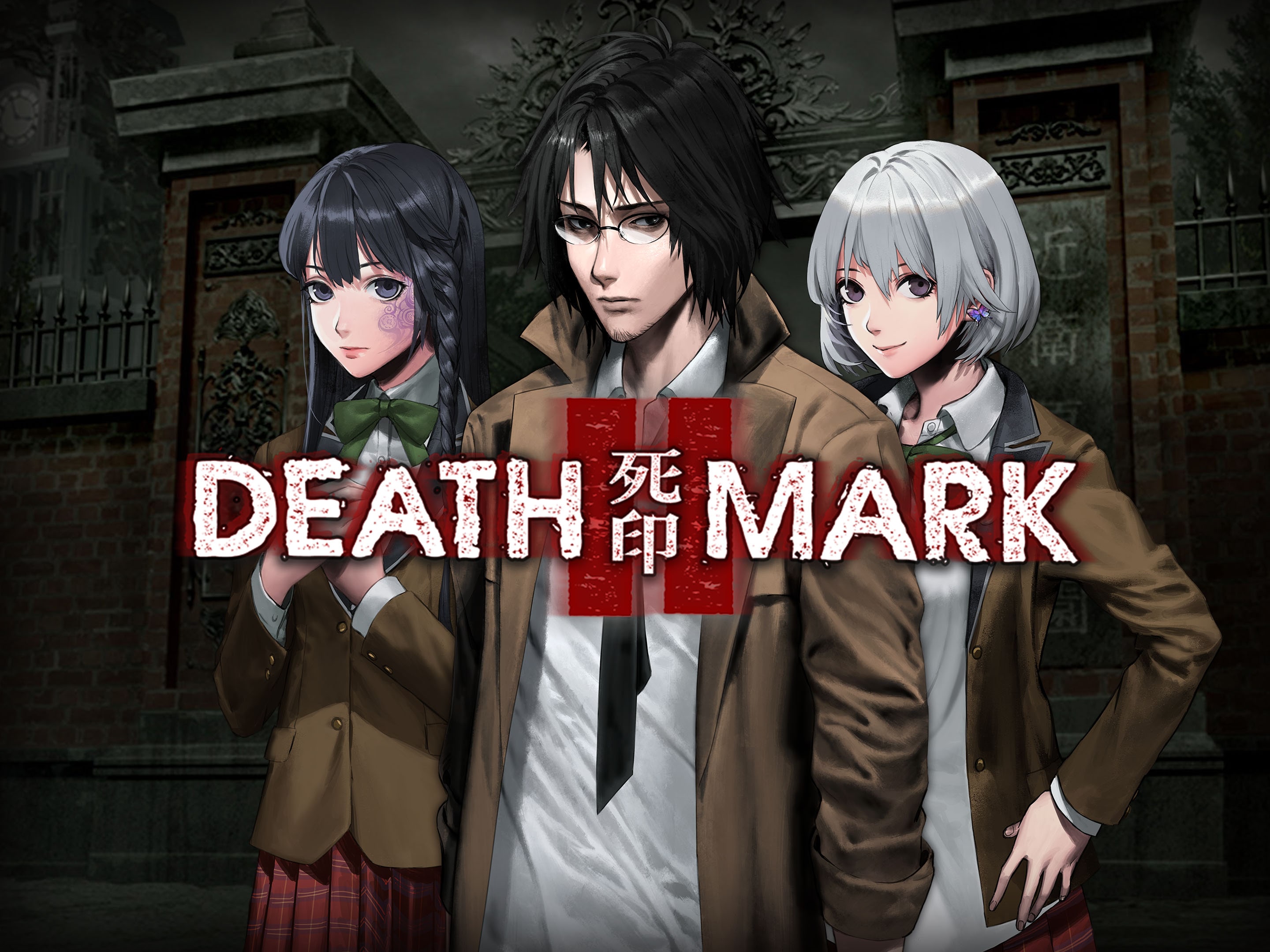
Console: PS5, Switch, PC
Developer: Experience
Release Date: February 15th 2024
Spirit Hunter: Death Mark II is a horror visual novel game with mystery and adventure mechanics that centers around exploration, puzzle-solving and its narrative. The third game in the Spirit Hunter franchise, Death Mark II is the most recent entry in the series and is actually a crowdfunded game. The game takes place four months after Death Mark, and is thus technically a midquel due to taking place a few years before NG. It is also a direct sequel to Death Mark, featuring most of the characters from the game and putting the player in Kazuo Yashiki's shoes once again.
 |
| A typical dialogue screen in the game, showing one of the new characters. |
While Death Mark takes place in multiple ruined locations and NG takes place in lived-in spaces after dark, Death Mark II entirely takes place within Konoehara Academy and the surrounding area. Four months after the events of Death Mark, Yashiki is hired by the newly appointed headmaster of the Academy to investigate the spiritual phenomenon happening in the school: a spirit only known as The Departed posted a notice warning that a certain student would die, and then that student vanished. During the game's seven chapters, more notices are found and Yashiki must save both the targets and the spirits involved in these attacks.
Due to taking place entirely in Konoehara Academy, Death Mark II faces an interesting dilemma: how do you make the game's location stay interesting during its entire runtime? I think it does a pretty good job at this by focusing events in different parts of the school to keep things from getting stale or repetitive, and the school itself is fairly big, consisting of a Special Building with a few key rooms accessed through a menu, the New Building which is the main school with three floors, the Old Building which is the rundown abandoned former building of the school with an identical layout, and a few side areas. It's a neat setting and staying in the same place allows each chapter to feel even more connected than they did in Death Mark and NG.
Death Mark II's story and structure marks a shift in the franchise as well: while Death Mark and NG are closer to adventure games, I'd argue Death Mark II shares more in common with detective games. They're two genres that share many similarities, of course, but I'd say that the latter is slower-paced and more centered around figuring out mysteries, while the former is more about finding things. As a result, the pacing is quite different from the previous games, with more dialogue in general and an overall slower pace. Thankfully, the writing is more than capable of not only keeping things interesting but also heightening the stakes. The Departed is even more believable of a threat than Kakuya from NG, and the mystery surrounding their identity is done very well, with good red herrings and foreshadowing. There's also a bit more humor this time around, which is appreciated: people do make jokes here and there after all, even in stressful situations.
 |
| A fun example of the characters' personalities shining through in the dialogue now, featuring the returning Shou. |
The cast of characters in Death Mark II is mostly composed of the cast of Death Mark, with two characters not returning at all and two having a short cameo appearance, as well as new characters from Konoehara Academy. Unlike in Death Mark, where the translation quality was a bit stiff, the characters here really have their own clear personalities, to the point that sometimes you would reasonably be able to tell who is talking even just with the way their dialogue is written, which is fantastic. The new characters are just as clear-cut in their personality and are good additions overall. Just like Death Mark, the cast of characters supporting Yashiki changes every chapter, keeping things fresh. There once again is good reasoning for their departures and arrivals as well.
Speaking of Yashiki, he feels much more like a real person now, which makes sense contextually but is just very welcome in general. While his introverted nature is still present, you get a better sense of his inner feelings, his values and his motivations in this game. The events of Death Mark II are a lot more tragic than those in Death Mark, so it was nice seeing him react to such things. His interactions with the returning characters showcase his bond with them, while his interactions with the new characters are refreshing... for the most part.
 |
| One of the "horror illustrations" in the game, showing The Departed in all its glory. |
The game, as expected of the series by now, enjoys highlighting taboo things. A lot of the game's spirits are focused around love in one way or another, with one being about gay love (actually handled quite well, to the point that it made me shed a few tears by its conclusion) while another is about female students being in love with a teacher. The latter is also something the game pushes at with Yashiki and two of the new characters, female students Michiho and Himeko, with the former being flirty with him. The game simultaneously has him under suspicion of pedophilia (rightly so, considering the circumstances these suspicions arise) by a secondary character, but Yashiki, in no uncertain terms, never shows an inkling of romantic interest in them, though he does end up caring for them more like a father figure. Still, it's all a bit uncomfortable, including a scene where both are found in their underwear with bugs crawling over them.
Thankfully, that's really the only awkwardly and overtly sexual/fanservicey large "horror illustration" in the game. In Death Mark II, these full screen illustrations are at their best, with truly disturbing (and unique!) death scenes and some really effective environment work, and they don't skimp on the gore when needed. The majority of the game's environments are the school itself, though, so it's only natural that most of the environmental art is pretty tame this time around. It's a bit strange how mold and insects are mentioned often when investigating, but not really reflected in the art itself, which isn't unexpected of the series, but a bit disappointing. Still, the game manages to make some areas truly creepy. That's why I don't think it's that big of a deal that most of the environments aren't that scary: it makes the scary ones stand out way more. I think it shows a level of storytelling maturity from the folks at Experience compared to NG and especially Death Mark.
 |
| Daimon and Hiroo's designs from Death Mark (right) and Death Mark II (left), showcasing the shift in artstyle. |
The character designs are both good and disappointing. Fumiya Sumio's style has changed since the previous two Spirit Hunter games, and the character art's quality has gone up significantly as well as providing characters with multiple facial expressions as needed. However, the poses are a lot less dynamic, almost all being of the character standing in a ¾ angle, facing towards the left but looking at you. The returning characters have new outfits as well for the most part, and while there's good changes like Hiroo and Yasuoka's designs, it's disappointing (but contextually logical) to have both Ai and Shou dressed plainly in the Konoehara Academy uniform. It's not that it's bad, but it does make them feel much blander. The change in artstyle is going to be a subjective thing at the end of the day, and I think I prefer the new artstyle, though I won't deny that it loses a bit of its dark aura.
For the spirits, they're almost all absolutely horrifying with a good mix of eeriness and body horror. Some of their designs (handled by Akifumi Yamamoto and Rokutaku Sakamoto) are amongst the best in the series, I'd argue, though there's some that feel out of place, coming across as more cartoony than scary, though it's still got macabre energy. I'd say The Departed is the clear highlight.
 |
| Yashiki and Hiroo investigating a classroom. Most of the exploration gameplay looks like this. |
Perhaps the biggest change in Death Mark II, however, is the shift from first-person room-based exploration reminiscent of a dungeon crawler to a seamlessly sidescrolling third-person view. Naturally, this has both a positive impact on the game as well as a negative one. Positively speaking, the sense of space of the game's environment is far clearer: exploring the school feels natural, and there's a much better sense that this is a real place, rather than a handful of rooms. It helps the immersion tremendously, and makes the whole story far more believable. The character sprites are really nice and they have some idle animations as well, though the running animations are a bit stiff.
The negative aspect has to do with pacing, in a way: exploring an area can be more tedious, and besides going left and right there isn't much variation to what you do. There are sections that transition into first person like in the previous games, so in a way it's the best of both worlds. It seems Experience realised the flaws of this new perspective, though, since there's a fast travel button back to the Infirmary (the safe room of the game) and you often can leave the Infirmary and start in different sections of the school rather than always at the entrance.
 |
| An early and typical example of a Suspensive Act. |
Death Mark II gets rid of the Death/Crisis Choices of the previous games and reworks the combat sequences of NG into an all-encompassing system called a Suspensive Act. Here, you'll be faced with a spirit (or sometimes an NPC or dangerous situation) and need to act accordingly. To do so, you'll be tasked with choosing either Yashiki or his current partner (or make them team up), then select one of the pre-selected items, and then what to do with said item. Death Mark II eschews the time limits the previous games had in these situations, and instead has a health system, and this is mostly where it comes into play: actions have a health cost to them, and there is a success probability as well that is seemingly tied to the RPG-like stats of each character, but not explicitly so, so it's difficult to tell. Exploration and some story events can also lower Yashiki's health a little bit. Luckily, you can always go back to the Infirmary to instantly recover.
Failing the success check will simply reset the scene without recovering the health cost, but it will make that action's success rate 99%. If it's the wrong choice, the chosen character(s) will take damage. The RNG element feels unneeded and while it didn't cause me strife, I've seen many complaints about it. I suppose for me it forced me to be more careful with my actions, but it still doesn't change the fact that it's needless friction. The series still hasn't fully figured out a way to make these tense encounters naturally stressful, but I'd say this is the best try they've had. This Suspensive Act system also allows the Partner system to finally feel like it has an actual use by using the character stats to change the success rate.
 |
| The only collectible in the game: the eerie tooth. |
A big improvement is the side content: while NG had the game-long D-Man sidequest, Death Mark II has the Lost Souls, represented by eerie teeth you can find across the school. Each chapter has unique Lost Souls, requiring you to explore thoroughly each time. It's reminiscent of finding worn-out talismans in Death Mark, but instead of being the same line of dialogue every time, each and every single eerie tooth is found in a different scenario that adds to the worldbuilding and atmosphere of the game, and it's a huge improvement I really liked. Plus, the Lost Souls are used to trade for spirit items at the Infirmary, which give you boosts to defense, success rate, and reducing the action cost, and finding a certain amount will level up Yashiki, giving him and his partners more health and healing them on the spot. I really recommend looking for these in every chapter, and there's even a tracker in the Infirmary to make sure you didn't miss any. A handful of them are time-sensitive, however, which is a little frustrating. Still, these are really well done and I found them fun to look for. Perhaps that's why I never had trouble with the Suspensive Acts.
However, with this perspective and these mechanics, I feel like Death Mark II doesn't quite leverage its potential to its fullest when it comes to horror. The rather static setting is perfect for scaring the player by making small changes to the environment (which they'd likely notice while hunting for Lost Souls at the very least) or even by having kind of small jumpscares Death Mark had. Hell, when I first saw this perspective shift, I fully expected there to be a chase scene or two, or a timing-based stealth section. None of that is in the game, and it's kind of just played straight. Having lights randomly flicker, doors slam in the distance, some wind blowing papers around... I feel like a lot was left on the table considering the potential there. Even if all scripted, having a little more ambient tension felt like it was missing.
 |
| One of the handful of "Cursed Rooms" in the game, where Yashiki and his Partner constantly lose health. |
There are some jumpscares in the game, optional like in NG, but these are almost exclusively during screen transitions: your controller will suddenly vibrate and a loud sound will play as an image of The Departed or some wiggling text appears on screen. It got me good the first time, but every other time was kind of a groaner. I think both NG and Death Mark II fail to capture the genuine tension or stress of Death Mark, and it's a bit of a shame. Still, there's plenty of horrifying things in both, especially Death Mark II, so it's fine, I'd say. Just a bit disappointing.
There's also an aspect of the game that feels truly undercooked: the Cursed Rooms. A handful of times in the game (with the first one being about a third of the way through!), you'll enter a room that glows red. Here, Yashiki and his Partner's health will constantly deplete one point at a time, and you need to explore and find the cursed tooth causing the curse. To make matters worse, you can't run until it's done. These are a big nothingburger: since the game is 2D, you just walk from left to right and investigate everything until you find the tooth and crush it. There's two in the late game that are a bit better, but it's still a superfluous mechanic that doesn't add much to the experience.
I must note, there's something that Death Mark II does that is very rare for me: it has a "true ending" that I find worse than the standard good ending. Naturally, I won't go into spoilers, but not only is it worse, cheapening the game's main tragedy to a point, it also just doesn't add anything to the overall plot. It's also really not hinted to exist outside of some Gallery entries not existing, and even then the way you get it is pretty obscure. It's an odd ending I didn't really like, and it feels like a weird afterthought with some odd implications I didn't really like. There's also an extra chapter to the story, unlocked after the main game, that takes about 15 minutes to complete and is really just a fun little bonus that links to NG. I enjoyed it despite the potential retcon of time spent between Death Mark and NG.
 |
| What's that in the mirror...? |
Once again, the music is handled by Naoaki Jinbo, and this time around I don't find it as perfect as in Death Mark and NG, namely because of some instrument choices. Most of the music is about as perfect as it could be, especially the spooky tracks and the returning ones, but some of the tracks during dialogue scenes feel strange. The use of a melodica and a flute that might be a recorder (though I'm not sure, I just know it's a bit grating) are bizarre choices and I never got used to them. Thankfully it's only a couple of tracks, but in a game with so few, it stands out. There's also some poppy vocal tracks that play in two or three spots that don't feel appropriate at all. However, Death Mark II features even more voice acting than NG, even having Yashiki say things when investigating something as well as some small lines during idle animations. Each character even has a unique panting voice while running, which can be a little annoying but I found it added a lot to the atmosphere of the game. While investigating, it's almost always silent, which I'm kind of mixed about. It's more immersive, but sometimes instead of being scary it's a bit dull.
PROS AND CONS
PROS
• A fantastic story with pretty great writing and a compelling mystery.
• A good return from the Death Mark cast alongside some welcome new faces.
• Fun exploration that's especially incentivised with the Lost Souls.
• Suspensive Acts are probably the best "live or die" sections the series has.
• The 2D perspective is mostly a good change, making the characters and environments feel more tangible.
• Great art, especially for the "horror illustrations" and the majority of the spirits.
• Very few, if any, typoes.
• Overall good soundtrack with some welcome voice acting.
• The slower pace helps make the scary moments stand out more.
CONS
• Suspensive Acts needlessly have an RNG element that can kill you if you're not careful with your choices.
• Exploration can be a bit tedious over time.
• "True" Ending is worse than the standard ending and isn't hinted at enough in the first place.
• Overreliance on silence during investigations.
• A handful of music tracks are a bit grating.
• Some slightly uncomfortable undertones in the story.
WORTH PLAYING?
Absolutely, especially after playing Death Mark. Death Mark II is the highest quality game in the Spirit Hunter series, and I'd recommend playing Death Mark purely so you can come into Death Mark II with a better understanding of the world and characters, despite that game's lackluster localization. NG isn't necessary to play before this, but there are a handful of references to it that are pretty rewarding as a fan of it. Death Mark II is well-written, disturbing, a little uncomfortable, and surprisingly emotional in parts. The new perspective keeps the game fresh from its predecessors and helps it feel like a unique experience.
Honestly, having now played the entire Spirit Hunter series so far, I think all three entries are worth playing. All three aren't perfect: Death Mark has a lackluster localization and some half-baked ideas, but it's easily the scariest of the three. NG has the best cast of characters, but it's a bit lacking in scares and visceral imagery as well as having the weakest villain. And Death Mark II pretty easily has the best story of the three, but its new mechanics can be slightly polarizing and one of its endings kind of sucks in my opinion.
I'd consider this trilogy a hidden gem: all three games offer a good story that ends in a high, a likable cast of characters, interesting and gruesome mysteries, and some fun visual novel/adventure gameplay. I'm really glad I have all of them physically on Switch, and I recommend them to anyone that enjoys visual novels and horror. They're a little pricey for what they are in my opinion, but they're still worth going for at some point. Just make sure to set your expectations to their level: Experience is an indie company, so there are some hiccups along the way that are to be expected. Nevertheless, I thoroughly enjoyed this little trilogy, warts and all. Death Mark spooked me, NG hooked me, and Death Mark II gripped me.
Excitingly, while I was researching Experience, I found out that as recently as September 30th this year, they successfully crowdfunded a full remake of Death Mark that will come out in Japan around 2027. This remake is supposed to fully remake the game in 3D and add quite a bit from what I can tell, and they've even funded an extra DLC chapter. It's worth noting that Death Mark's DLC chapters, Chapters 6 (which is just included on Switch following the good ending) and 7 (which is exclusive to Switch in the West) are not a part of this remake. This DLC chapter will be brand new. As a result, though I'm excited about it and would recommend perhaps waiting for it, I still think the two DLC chapters are worth playing, and getting the context for both NG and Death Mark II is more than worth it.
Comments
Post a Comment